Victoria's Secret Fashion Show â€ëœlack of Inclusivity'
Victoria'due south Secret recently announced a cast of new "angels." They include American athlete Megan Rapinoe, extra and activist Priyanka Chopra Jonas and the brand's first transgender model, Vanetina Sampaio. Together, they speak to a far more diverse paradigm of beauty than was mutual for the once pop company.
Victoria's Clandestine learned a lesson other leading fashion brands and the industry at big are coming to realize: diversity sells.
Ameliorate representation
This isn't surprising. For years, consumers have called for greater inclusion and better representation in mainstream fashion. And the industry's virtually advanced players have already responded, including Rihanna's much talked nigh Savage X Fenty and Summersalt'due south "every body is a beach trunk" campaign.
Consumers are willing to back brands that feature diversity with their praise and more than importantly, their dollars.
In the last two years, way brands like Tommy Hilfiger, Nike and lingerie competitor Aerie all made efforts toward greater inclusion. They feature plus-size models, transgender models and models with disabilities in their stores and online campaigns.
Each brand has been rewarded with public kudos and a flurry of consumer purchases. Nonetheless others in the industry lagged. Despite Victoria'south Hugger-mugger's latest inclusion and diversity efforts, models with disabilities were missing.
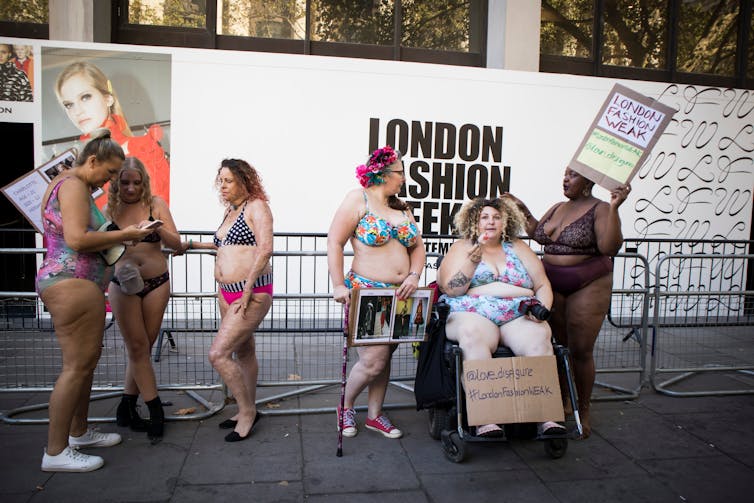
Embarking on diversity initiatives
According to our new study, A model who looks similar me: Communicating and consuming representations of disability, the $iii trillion mode industry has, until recently, paid little attending to gender, sexuality, race and disability.
We ask how and why the industry almost all of a sudden embarked on diversity initiatives.
We focus our attention on inability considering it's traditionally seen every bit inconsistent with fashion. The industry largely saw a person with disabilities equally someone who can't embody, reflect or convey beauty. In other words, disability would plough off consumers.
Our analysis over v years of three mainstream style magazines - Vogue, InStyle and Harper'south Bazaar - revealed not a single person with a inability appearing on the embrace. A expect at 2,500 ads in InStyle turned upwardly similarly lilliputian.
And so we turned to the recent and well-known Nike, Aerie and Tommy Hilfiger campaigns that featured a various cast of models, including those with a range of visible and non-visible disabilities.
Tommy Hilfiger'due south entrada went a step farther. The brand adult adaptive vesture specifically designed for people with disabilities — a step few others accept taken.
This inclusion, though hugely important, often comes with more "sanitized" depictions of disability – creating images thought to be "more palatable" to consumers.
We found that editorials often reinforced distinctions between "power" and disability, suggesting that disability is something to be overcome. For instance, when athletes were praised for pushing the limitations of their disability. Sometimes, no photos of people with disabilities were included in editorials almost them. When models with disabilities were included, they were frequently treated as also unremarkable to apparel in brands referenced by the mag's editorial staff.
Disability, diversity and inclusion efforts
So why has disability go a more meaning part of the manner industry's diversity and inclusion efforts?
Some brands have the bound, challenging beliefs well-nigh potential consumer backfire. They lower perceived risk every bit other brands follow conform. Run a risk, though, is likewise lessened when consumers answer favourably to more inclusive initiatives, sending a message to the industry at large.
We analyzed more than 200 online consumer comments near Teen Vogue'southward "The New Faces of Style" entrada that featured three models with disabilities: Chelsea Werner, Mama Cax and Jillian Mercado. We institute that an overwhelming bulk of consumers gave praise and admiration.
1 viewer thanked Teen Vogue for "making neat changes." Some other, eager for inclusion, wrote: "Let'south see this on a regular footing, please." Brands like Pigeon Beauty and Allure left comments on the magazine's Instagram page.
In response to Attraction's praise, ane viewer called on the mag to "join the Inclusion Revolution likewise." It wasn't long after that Attraction announced its own series on "the beauty of accessibility," positioning Ellie Goldstein, a young model with Down's syndrome, on the embrace of their digital print magazine.
Poised for a reboot
Away from social media and afterwards more than a twelvemonth in lockdown, the fashion industry is poised for a reboot. Couturiers like Dior and Chanel have convened in Paris for the industry's first set of in-person shows since the pandemic began.
As Victoria'southward Secret and others gear up near reimagining the world that volition be, we wonder what the "inclusion revolution" will look like — and whether people with disabilities volition continue to be office of information technology.
We should look to manufacture leaders for signs of lasting change, just consumers matter too. They must continue enervating that fashion and beauty brands engage meaningfully with their efforts towards diverseness and inclusion.
These demands will demand to movement across casting calls and rails models. They must include boardrooms and brand teams – those who ultimately influence and brand decisions well-nigh what consumers see and purchase.
0 Response to "Victoria's Secret Fashion Show â€ëœlack of Inclusivity'"
Post a Comment